Saturday, April 6, 2013

Climategate

Saturday, April 6, 2013
1:16 A.M.


I've only recently heard of the "Climategate" scandal. Whenever I'd be looking at an online news article that had something about global warming and allowed people to comment on it, a surprisingly large amount of people would bring up the word "Climategate." Usually, they would juxtapose the mentioning of Climategate with some bold, unfounded statement such as "Global warming is a hoax." I wondered if this scandal would provide enough evidence to show that climate scientists were truly conspiring amongst themselves to try to convince the public that climate change was occurring when it was not. Being an innocent, naive college kid, I always believe that our government is wonderful and never lies to the public. As history has shown, this is not often the case.

I found a hard time believing Climategate because I thought it was simply impossible for all (or at least the vast majority) of incredibly smart climate researchers to participate in such a conspiracy. I also had my doubts that the Earth wasn't clearly warming. I wore sweats throughout elementary and middle school, and although I upped my style to shorts/jeans/khakis, the spinning image of me in sweats was implanted in many of my fellow high school students that I knew in middle school. As such, I was voted "most likely to wear sweats" in the Garfield High School yearbook. This winter, I've only worn shorts. If that's not incontrovertible evidence for global warming, I don't know what is.

The Climategate scandal began in November of 2009 when a server at the Climatic Research Unit (CRU) at the University of East Anglia was hacked externally. This hacker then copied thousands of emails and computer files and sent them to a variety of locations on the Internet. These emails eventually fell into the hands of climate change skeptics/deniers and became a popular subject for these people to blog about. In response to the content the emails, these people asserted that climate scientists manipulated data and attempted to suppress critics of climate change. These accusations of scientific conspiracy were rejected by the CRU, with the CRU claiming that the emails were taken out of context.

On December 7, 2009, there was an international climate change conference in Copenhagen geared towards solutions to mitigating climate change. Conveniently enough, these emails had reached the mainstream media at this time. In response to news of the conspiracy, The American Meteorological Society, the American Association for the Advancement of Science, and the Union of Concerned Scientists (UCS)  all stated their support for the scientific consensus on climate change.

The emails were reviewed by eight committees and were found to have no evidence of any fraudulent activity. Climate change skeptics, however, looked at certain emails (which were filtered by the hacker) and sought to provide evidence to the public of climate scientists saying things that contradicted with their opinions as made public or admitting that global warming was indeed a big fat conspiracy. These skeptics focused on a couple specific quotes that would seem to provide evidence of a conspiracy; one phrase that was used in particularly was "the fact is that we can't account for the lack of warming at the moment and it is a travesty that we can't." This sentence was taken out of context, as it was part of a discussion on monitoring energy flows involved in short-term climate variability. Regardless, skeptics jumped on these phrases and disseminated the idea of a massive conspiracy to the public.

The responses to these inquiries varied sharply along political lines. Many Republicans (most notably Wisconsin Representative Jim Sensenbrenner) argued that these emails provided clear evidence of data manipulation and suppression by scientists in order for them to achieve their own ideological and economic goals. Many democrats and scientists affiliated with the Obama administration agreed with the results of the inquiries and held that these emails were completely taken out of context and didn't do anything to undermine the "very strong scientific consensus" that the Earth is warming due to the anthropogenic emissions of greenhouse gases.

Climate skeptics suddenly became climate celebrities due to Climategate. There are always people who think some governmental conspiracy is going on, but these emails were taken as a golden ticket for skeptics to prove to the public that global warming was a big fat hoax. These accusations by skeptics were shot down by Nature, The Telegraph, FactCheck, the Associated Press, the New York Times, and a bunch of other high profile magazines, newspapers, and disseminators of scientific and political information to the public. Regardless, the rumors of wrongdoing were so widespread by this point that climate scientists received numerous email threats - in some cases, death threats - in the wake of the hacking.


These hackings did nothing to undermine the scientific consensus on climate change, but they did undermine the public opinion. One of my favorite quotes applicable to this situation comes from Newsweek journalist Sharon Bagley, who stated, "one of the strongest, most-repeated findings in the psychology of belief is that once people have been told X, especially if X is shocking, if they are later told, 'No, we were wrong about X,' most people still believe in X." When I see comments on global warming articles that say that climate change is a lie and cite Climategate as an example, I regard it as the tendency for people to distrust their government, and, to be completely honest, a method of venting against the current Obama administration. In the end, Climategate was nothing more than people, most notably high-profile climate skeptics, jumping at the opportunity to take these emails out of context and spread their ideas to the public while accusing scientists of conspiring to do the same thing.

There are lots of misunderstandings in life. When my brother was really young, he took a big gulp of Henry Weinhard's thinking that it was Martinelli's non-alcoholic sparkling apple cider and spit it right out in disgust... it was pretty memorable. I have doubts over climate change skeptics truly 'misunderstanding' the emails; I think there is more evidence to support the notion that the emails had no wrongdoing than the contrary. I do, however, think there is a misunderstanding in the public. Global warming is hard to accurately communicate to the public because it is such a complex topic. In my experience, I have found that many people's opinions of climate change stem from the simple, largely unfounded claims that circulate throughout our politics and culture, such as claims that 'Climategate proves global warming is a hoax' or 'Hurricane Sandy proves that climate change is occurring.' It may not lead to as much economic success for news companies trying to gain prominence in our society, but an emphasis should be placed on accurate, full, and, dare I say, less concrete articles about climate change.

Thanks for reading,
Charles

Friday, April 5, 2013

Recap of Today, a Chance of Thunderstorms Saturday, and a Comparison of Satellite Images

Friday, April 5, 2013
12:20 P.M.

Thunderstorms in Seattle are very rare. Seattle doesn't tend to get much in the way of 'severe' weather, where 'severe' is defined to be tornadoes/hail/rain/wind etc. from strong thunderstorms. When we do get thunderstorms though, it's always fun to see, and we get occasional storms that drift westward over the Cascade crest in the summer. These storms don't usually bring much in the way of precipitation, but they can make for a fantastic light show.

First, a recap of today - we saw some fairly heavy rain come through Western Washington this morning, but the Seattle area was largely shadowed due to the Olympics. Our prevailing winds associated with storms coming off the Pacific are from the southwest, so places northeast of the Olympics like Sequim often enjoy dry and sometimes even sunny weather while it is pouring 60 miles to the southwest. When the upper level flow is westerly, however, places directly to the east of the Olympics end up getting shadowed. That's why Seattle has been drier this morning and afternoon afternoon than I originally thought it would be. Quite a bit of rain fell in the super early morning hours though... almost a half inch as of noon today.

The picture below shows the prominent shadowing over the Seattle metropolitan area and points north this morning. When the flow is perpendicular to the Cascades as it is in this radar picture, the mountains are the most efficient at forcing air to rise, and there is a lot of orographic precipitation on the west slopes. The east slopes are completely dry.


Another system is currently coming into the area right now, and you can see it on the latest radar image and the latest visible, infrared, and water vapor satellite images.


01:00 pm PDT Fri 05 Apr 2013: UW West Coast 2 Visible Satellite

01:00 pm PDT Fri 05 Apr 2013: UW West Coast 2 Infrared Satellite

01:00 pm PDT Fri 05 Apr 2013: UW West Coast 2 Water Vapor Satellite
Now, I usually don't show all these satellites, but since I have time, I thought I'd give you a brief rundown of the differences between the three.

The first satellite image I posted is known as a visible satellite image. The idea behind this type of imagery is pretty simple; a satellite takes a picture of what the surface of the Earth looks like at any given time. Visible satellite images are great because they show exactly what the clouds look like and they can do this in pretty high resolution. I'll often show visible satellite pictures when we have a showery pattern and/or convergence zone over our region because they are the most effective at illustrating the finer details of the clouds over our area. One caveat is that these these images are useless at night since there is no sunlight over the area. It would be really cool if we equipped a satellite with some night-vision goggles to show us what the clouds looked like then.

The good thing is that we have done that! The second type of imagery I posted is infrared satellite imagery. All objects emit radiation proportional to their temperature, and an infrared satellite measures the amount of radiation emitted from an object and converts it to temperature. Infrared imagery is extremely useful because it tells us the temperature of a cloud. In this color-enhanced picture, the coldest cloud tops are in color, and the warmer ones are in grey. One interesting thing to note is that the land also emits infrared radiation, and one can therefore use an infrared image to determine the temperature of the land. See how the land around 60 degree latitude line in Canada is much more gray than the Southwest? As evidenced by the visible satellite picture, there are no clouds in both regions, but since the ground temperatures in the Southwest are much warmer, it appears blacker than the northern Canada area.

A downside to infrared images is that they have trouble picking up clouds with warm tops. Visible satellite images clearly show fog, but infrared images often do not because temperatures at the tops of the fog are relatively warm compared to other clouds.

The third type of satellite image is a water vapor image. A water vapor image is a specific type of infrared image, but whereas the infrared image I described above primarily measures wavelengths in the 10-12 micrometer range, water vapor sensors on satellites measure wavelengths in the 6.5-6.9 micrometer range. Water vapor is transparent at wavelengths longer than this and on visible satellites, so that is why it doesn't show up on the previous two satellite images. A water vapor image is used to detect the amount of water vapor in the atmosphere.

Water vapor imagery is my favorite type of imagery because it can tell us the general flow of the atmosphere, specifically the 300-600 mb level of the troposphere which is a key region for storm growth and formation. Water vapor is always present, so you can see areas where the air is dry and areas where it is humid. In the picture above, red colors represent areas with low water vapor and green areas represent areas with high water vapor. Water vapor imagery is also very useful for determining where the center of low pressure in a specific storm is, as a storm undergoing cyclogenesis carves out a "dry slot" near the area of lowest pressure. I remember a storm back on October 18, 2007 that was poorly forecast and the center of low pressure was impossible to detect on infrared or visible imagery. The water vapor image, however, showed a clear dry slot, and this was used by the National Weather Service to determine where the low actually was.

One other note: there are only two satellites that the U.S. uses for most of these images: the two geostationary satellites that are located over the equator at a height of 36,000 km (GOES-West and GOES-East). There are also polar orbiting satellites, but I'll touch on those in a later blog. There are not separate satellites for each image; each satellite has the capability of taking visible, infrared, water vapor, and a host of other satellite images.

Alright, now a perfectly seamless transition back to thundershowers. I'm pretty slick.


We get our thundershowers when we have have unstable air over the region (i.e. a large decrease in temperature with height). Most of our thundershowers occur during spring because the upper atmosphere is very cold and the increasing solar insolation due to higher sun angles heats up the lower part of the atmosphere. Some of you may be familiar with lapse rates... as air rises, it cools at a rate of 9.8 degrees Celsius per km if it is unsaturated and 6.5 degrees Celsius per km if it is unsaturated. If the environmental lapse rate (the change in temperature in height in the environment) is higher than either of these lapse rates, an air parcel that rises will cool at a slower rate than the environment around it, and it will continue to rise because warmer air is less dense. This is what is meant by instability - the tendency for air parcels to rise.

We'll see if we get any thunderstorms tomorrow. It's kind of a crap-shoot, so don't get mad at me if I'm wrong. In case you haven't noticed, that happens a lot.

Charlie

Thursday, April 4, 2013

Rain

Thursday, April 4, 2013
2:29 P.M.

UW Atmospheric Sciences Composite Northwest Radar Loop: Valid 2:24 P.M. 4/4/2013


"Hey buddy! It's been awhile! How are you? What have you been up to lately? Do you and the jet stream still have that thing, or are you cut off from her lovely geostrophic flow?"

That's what I found myself saying to myself this morning as I walked around campus. We've had some very nice weather around here, but I'm very happy to see the rain. While it is sad to see the raindrops knocking the flowers on the cherry blossoms in the Quad to the ground, the rain has done wonders for my allergies, and it's always nice to have a change. I don't know how valid this is, but I always have this image in my head of the Earth just getting dirtier and dirtier the longer we are rain-less, and it's wonderful when the Earth finally takes a shower and cleans herself off.

Let's take a look at what is happening out there. Here is the latest water vapor satellite picture from GOES-West

Valid 02:30 pm PDT Thu 04 Apr 2013 - UW 4km West Coast Water Vapor Imagery

As you can see, we have a rather unorganized system rolling through our area. The occluded front is what is bringing us the rain. A little meteorology 101: an occluded front forms when a cold front overtakes a warm front. I have some more info on fronts here.

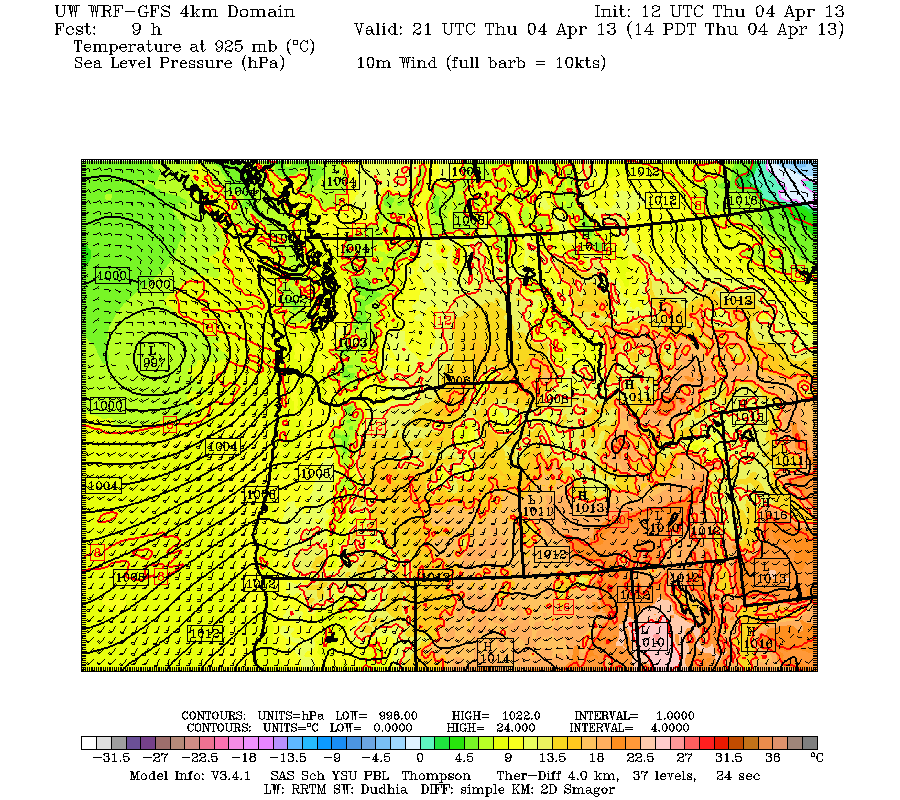
Below is the WRF model output for the surface winds, temperature, and pressure from the 12z GFS run this morning. You can see the low pressure system making its way up the coastline. It is not very compact, so it is not bringing strong winds to the area, even on the coast. That's not to say it isn't a bit breezy; there are small craft advisories for most of the coast and gale warnings extending from Willapa Bay to Florence, Oregon, but this is nothing out of the ordinary.

Valid 02:00 pm PDT Thu, 04 Apr 2013 - 9hr Fcst: UW 12z WRF-GFS 12km SLP, 10m winds, and temp 
It is important to note that this picture is a model forecast and does not represent the current conditions at this time. I just like to use it because it is good enough for our purposes and I don't know of many very good surface weather maps. If anybody can point me in the right direction for quality surface analyses, that would be appreciated.

We will have a slightly stronger system come in Friday bringing additional rain and wind. The Skokomish River may reach flood stage on Saturday and Sunday, but any flooding would be minor. The weekend will feature showers and sunbreaks, and then we will dry out for next week. The mountains could see moderate amounts of snowfall over the weekend so pass travel could be a bit dicey. Last chance to go skiing!

Thanks for reading, and not getting irritated over me inviting a trillion people to the Facebook group all at once.

Charlie

Wednesday, April 3, 2013

Climate Change and Love

Tuesday, April 2, 2013
11:01 P.M.


There is so much debate among the public about climate change. Is it real? Is it serious? Is it worth doing anything about? Or is it just a 'hoax' carefully designed to allow certain people to selfishly accomplish their own goals?

The consistent readers of this blog know my opinions on global warming. It is occurring, it is serious, and it is poorly communicated to the public. In fact, one of my main inspirations for writing this blog is to spread accurate information about climate change to the public and encourage others to do the same.

But what's the real reason that compels us, as a human race, to take action against global warming? It's not politics. And, to some extent, it ultimately isn't even about the environment.

It's about love.

When I was in elementary school, I was taught that humans need three things - food, water, and shelter - to survive. When somebody asked me about the three things I would need if I was stranded on a desert island, I would respond accordingly. Ain't nobody got time for a pet dragon when your life is at stake.

But I think there actually should be a fourth need, and that is love. Love is so ubiquitous in our lives... almost everything is related to it. Not everybody may believe in global warming, but nearly everybody has the capacity to love, whether they love a certain person, the human race as a whole, or the beauty of the entire Earth. I say nearly everybody in the same way that hand sanitizers claim to kill 99.99% of germs. I don't know a single person who does not have the ability to love.

When asked about his belief in climate change, 2012 Republican presidential candidate Jon Huntsman said that "all I know is 90 percent of the scientists say climate change is occurring. If 90 percent of the oncological community said something was causing cancer we'd listen to them." When we sense that we, or loved ones, or anyone for that matter, are in danger, our innate love comes through, and we take measures to prevent harm to the people we care about, whoever that may be.

The scientific community overwhelmingly believes that climate change and ocean acidification are occurring and that these atmospheric and oceanic changes have the potential to cause damage to ecosystems and conflicts over resources in the future. A study was recently done on the effects of rising temperatures and decreased ocean pH levels in a controlled environment, and it was found that the combination of rising temperatures and increasing acidity will spell disaster for coral.


I have seen this study before, but unfortunately I don't know any specific details about it. I'll write more about ocean acidification in another blog, as it gets nowhere near the attention of climate change when it is likely a bigger problem for the immediate future.

Looking at this picture above, we can see the modeled effects of increased carbon dioxide levels and ocean temperatures on coral. Some people have an immediate reaction to a picture like this. Others may not. But for those who initially don't see the point to saving coral reefs due to them not having any influence in their lives or the lives of others they love, I propose a new thought paradigm. Try to surrender your steadfast beliefs, and try to think about our instinctive, universal love. Think about the people that a change like this would affect. Think about the people who obtain their food directly or indirectly from a coral reef ecosystem. Think about people like Jacque Cousteau, who dedicate their entire lives to spreading their love for the ocean and all its inhabitants. It's perfectly fine to not care about the beauty of coral reefs, but think about the happiness of the people who do, and think about how devastating a change like this would be. Ocean acidification is, of course, a global problem, and its effects have already been felt strongly in the Pacific Northwest - most notably with the massive die-offs of oyster larvae in hatcheries located on protected bays on the Pacific Coast. If someone you love is an oyster fanatic, take the time to reflect on how ocean acidification would affect their life. To some people, loving the minute organisms that would suffer greatly in an increasingly acidic ocean is enough to catalyze a response toward mitigating ocean acidification. For others, the knowledge that other animals we care about - salmon, orcas, bluefin tuna - will suffer in an increasingly acidic ocean due to their decreased larval survival rates and the reduced carrying capacity of an ecosystem for their prey will inspire them to take action. Even if you don't care about the ocean whatsoever, chances are you have a friend who does, and the chances are even higher that one of your friend's friends does. In that circumstance, any commitment you make to do something about ocean acidification would be rooted in... you guessed it... love.

Global warming will change some people's lives to much greater extents than others. For a place like the Pacific Northwest, the biggest effects will end up being less wintertime snowfall and therefore lower summertime streamflows to support hydroelectricity, irrigation, and other water-dependent activities. These changes will affect the economy as a whole, so even if somebody is completely removed from nature, they will still experience the repercussions in the form of higher food prices and electricity bills. In drought years, they may hear of conflicts between farmers wanting to draw more water and conservationists/fisheries wanting to secure an adequate water supply for salmon runs. In Charlie's ideal world, the concern for others and compassion that we all have would play a significant role in attempting to reduce greenhouse gas emissions, conserve water, and be a more environmentally-conscious citizen.

The effects will be far more severe in other parts of the world. In Bangladesh, 10% of the country is expected to be submerged under water in the event of a 1-meter rise in sea level. Global warming is also predicted to perhaps bring stronger cyclones to the area due to increasing sea-surface temperatures, although the effects aren't completely understood at this time. The deadliest cyclone in recorded history, the 1970 Bhola Cyclone, killed up to half a million people in Bangladesh and far eastern India, with most of the deaths resulting from the storm surge as it flooded the Ganges Delta. A rise in sea-level associated with the increased ferocity of tropical storms would create the potential for even larger storm surges in the area, and the results could be catastrophic.

Stalin once said that "the death of one man is a tragedy, the death of millions is a statistic." Most of us can relate to the death of one person either because we have been in the situation of grieving after the loss of a loved one or because we imagine people who are close to us passing away and reflect on how tough such a loss would be for anybody else.  Rational thought would say that one million deaths is far more tragic than one, but people, including myself, are unable to truly comprehend how horrendous the death of a million would be, and therefore take it as a simple statistic. This is often the mindset I find myself subconsciously adapting when I hear of tragedies such as the Bhola Cyclone. I believe that this reaction is a defensive mechanism to help keep one's mental sanity and is not something to be ashamed of, but it is something to be aware of. 

Our best chance to mitigate climate change and ocean acidification is to draw upon our instinctive compassion for the others of this Earth. What if we just let go of our prejudices and worked together for the benefit of our planet and all its inhabitants? It's easy for the realist to list all the reasons why something like this could never work. But what is the virtue in doing that? Saving our planet, and our people, starts from the heart, and nothing is preventing us from taking that first step.

Sorry for the excessive sappiness. But the sappier the tree, the sweeter the syrup. Now that's food for thought.

Charlie

Saturday, March 30, 2013

Where's Credible Climate Information?

Saturday, March 30, 2013
12:59 A.M.


Finding Waldo took me about 15 seconds. I guess I just got lucky. But finding truthful, scientifically-accurate sites about global warming and climate change? Yikes. I'm still looking.

Thankfully, there are quite a few sites out there that have pretty darn good information and are scientifically sound. For me, a 'scientifically sound' site is one that is backed up my multiple, peer-reviewed resources and draws its information from a variety of sources. I am wary of sites that continuously cite one author or one group on either side of the 'debate.' I put 'debate' in quotations because despite what the public may hear, there is nearly unilateral consensus among scientists that the Earth is warming because of human emissions of carbon dioxide. Scientists differ on many other aspects, such as how strong the warming signal will be and how quickly the arctic will become ice-free. However, one must take into account that there are different projections of fossil fuel emissions for the future, and the responses in the Earth's climatological system will vary based on the amount of greenhouse gases emitted into the atmosphere.

Here are some sites I believe are good, scientifically-sound resources for information regarding climate change.


http://www.climate.org/ - Climate Institute

Well, this site easily wins the award for the best domain name. Almost as good as http://www.climate.gov/ (which is part of NOAA and is another great website).

The Climate Institute is a non-profit organization and their site is one of the best sites out there for essentially everything climate-related. Not only do they give a brief overview of what climate change is and discuss its affects, they help policymakers, scientists, institutions, and the general public create programs that address the climate change problem. They also make an effort to catalyze research on climate change and help communicate the scientific findings of current research to the general populace in a more approachable format. This site is great for people who want to know what is actually being done about climate change. Additionally, since climate change is such a multi-faceted issue, there are a lot of opportunities for people of various backgrounds to make a positive impact by providing information on possible places to travel to, seek employment at, or study at. They even have internship opportunities in Washington D.C.


http://www.epa.gov/climatechange/index.html - EPA Global Warming Page

What more can you say... it's the EPA. This page awesome for so many reasons. It provides a very approachable yet thorough discussion on why the climate is changing, what we can do about it, and what the effects are. One of the coolest things about this site is that you can look at the specific effects in different United States region. You hear stuff like "Global warming will make droughts worse" and other broad, overreaching, unhelpful statements like that. For the Northwest region, they specifically talk about the impacts of climate change upon water resources, forests, agriculture, food supply, and coastal resources and they give specific examples of how climate change will impact these things. They also talk about adaptation strategies, which is very important because climate change cannot be stopped; it can only be mitigated. A fantastic website in every sense of the word.


http://www.skepticalscience.com/ - Skeptical Science

The home page of this website reads "Scientific skepticism is healthy." Let me make this very clear: some scientific skepticism is healthy. I don't think James Dobson's attempt complete rejection of evolution is very healthy, but he's not a scientist and complete denial is different than skepticism. Anyway, there are a LOT of misconceptions in the public about global warming, and this site attempts to specifically address these misconceptions. Although I'm against 'biased' websites (and this could be interpreted as one), this one does it right. Their sources are good and their facts are right on. They even have a page that has climate change deniers to watch out for. Sarah Palin, Michelle Bachman, and Rick Santorum are all there. Richard Lindzen, a professor of atmospheric sciences at MIT notorious for his contrarian views on global warming and tobacco smoking, is also shown. The one thing I worry about is that this site can act to fuel a debate between those who believe in global warming and those who don't, and as I've personally experienced, being in these debates can be very frustrating.


http://www.realclimate.org/ - Real Climate

This site is similar to Skeptical Science in that it is not funded by any organization and is primarily an information resource composed by a variety of scientists who are passionate about global warming education. Many of the scientists who both support and oppose the global warming hypothesis have plenty of credentials, but the trick is to look at the sources they cite and the data they use. Go to their 'data sources' page and you'll see what I'm talking about.

The cool thing about both Skeptical Science and Real Climate is that they are largely discussion-based and you can always count on a fair number of comments to be at the bottom of each post. These comments can be very enlightening and many of them also link to other interesting sources. You don't get as much 'trolling' on these sites as you might think.

Alright, now on to the sites to watch out for.

Believe it or not, The Heartland Institute actually used this billboard. They took it down 24 hours after it was put up.
http://climateconference.heartland.org/ - The Heartland Institute - International Conference on Climate Change

If you search for The Heartland Institute online, the description for the site reads "Database of published research, primarily against environmental regulation." In 2012, The Economist called them "The world's most prominent think tank promoting skepticism about man-made climate change." The worst part though is the name of the event they sponsor to help spread their ideology: the International Conference on Climate Change (ICCC)." The ICCC is a conference that solely features speakers who oppose the mainstream scientific view of anthropogenic greenhouse gas emissions being responsible for global warming. It is completely different from the IPCC, which stands for the "International Panel on Climate Change (IPCC)." The IPCC was founded first.

The IPCC Fourth Assessment Report, which was presented in 2007, was produced by thousands of authors and editors from various countries and cited over 6,000 peer-reviewed articles. The Fifth Assessment Report is set to take place in 2014. The ICCC has had eight conferences so far, and most of them just involve some keynote speakers who deny global warming without much specific peer-reviewed literature at the events. They did produce an 880-page rebuttal to the 2007 IPCC report in 2009, and you can find it here. I should read it at some point.


http://wattsupwiththat.com - Watts Up With That

This website is ran by Anthony Watts, which is a fitting name for a scientist. (Cliff Mass, Anthony Watts... what's next? Charles Coulombs?). It advertises itself as "The world's most viewed site on global warming and climate change," a quote ascribed to it by another global warming skeptic who wrote about Climategate (I'll go into that whole thing in another blog... I've already spent 2 and a half hours researching stuff for this one!). I sincerely like his "Reference Pages" section of the site because it has a lot of useful data. Other than that, I dislike the site. Much of it seems more like a blog than an actual site. When somebody is posting videos of Al Gore and Bill Nye failing at doing a simple CO2 experiment (I kid you not, this is on the website) alongside their views on why there is no such thing as anthropogenic global warming, one has to worry about the credibility of the site.


http://climateaudit.org/ - Climate Audit

This site is pretty similar to that of Anthony Watts in many ways. It is chiefly run by one person - Steve McIntyre - and it is written in more of a blog style than a logically laid out website. Like Watts' site, this site has some great links to other sites, but I am unimpressed with McIntyre's blogging. The blogging style allows somebody to take a look at a specific piece of evidence and devote a whole post on how it does not support global warming, and that is what this site does. There are plenty of things that would seemingly contradict global warming; the growth of Antarctic sea ice is one example. The principle reason for the increase in sea ice is because there has been a general shift in the winds that drive the ice drift to a regime that is more effective for enhancing sea ice cover. In the limited space of a blog post, it is easy to provide a seemingly scientific reason for such a change to occur when in reality the reasons behind this change are incredibly complex.

There is very little debate in the scientific community about CO2 and other greenhouse gases driving the increase in temperatures we have seen over the last 50 years. There is more debate about what the effects will be. But there are a few high profile scientists (and a lot of high-profile politicians) who deny global warming altogether. Organizations like NOAA and the EPA need to do a better job of communicating reliable climate information to the public.

Thanks for reading. Three hours! But I learned a lot in writing this post, and I hope you learned a lot in reading it. Spreading accurate global warming knowledge is one of my main goals of this blog and is one of my main goals in life.

Charlie