Wednesday, November 30, 2011

Arctic Air Next Week?

Wednesday, November 30, 2011
1:01 P.M.


Yeah, I know No-Shave November is completely unrelated to weather. However, the model runs this morning made me hesitant about shaving my patchy, warming layer of facial hair. Remember how I was talking about how areas east of us would see very cold air next week due to the huge high pressure over our area creating a trough in the jet stream east of us where arctic air can invade? The big dome of high pressure is now forecast to move a little bit to the west next week or so.

If this holds true, we will see frigid temperatures, and if we have moisture, we will certainly see snowfall in the lowlands.

Take a look at the model from last night. I showed this picture in my previous blog post. The high is too far east for the Pacific Northwest to get cold air, but Montana would get frigid temperatures if this were to happen.

Valid 04:00 am PST Wed, 07 Dec 2011 - 180hr Fcst - UW 00z 36km WRF-GFS 1000-500mb thickness, SLP (last night's run)

This morning's run, just 12 hours later, is completely different. The high is further west, and Washington would be colder than a toilet seat in Siberia. Ok, maybe it won't be that cold, but high temperatures would be well below freezing, and low temperatures would be in the teens in Seattle with single digits in the suburbs.

 Valid 04:00 pm PST Wed, 07 Dec 2011 - 180hr Fcst - UW 12z 36km WRF-GFS 1000-500mb thickness, SLP

Look at that! Much colder air over our region, and the high is only slightly further west. This just shows the thickness of the atmosphere, where lower thicknesses generally equal colder temperatures since cold air is denser. Let's take a look at the surface temperature predicted at this time.
Valid 04:00 pm PST Wed, 07 Dec 2011 - 180hr Fcst - UW 12z 36km WRF-GFS 10m winds, 2m temp. SLP

In this picture, it is very cold over our region. There would also be strong winds through the Fraser River Valley as the cold arctic air spills into our region.
Valid 04:00 pm PST Wed, 07 Dec 2011 - 180hr Fcst - UW 12z 12km WRF-GFS 10m winds, SLP

Will this change? Absolutely. The models are not very accurate this far out. In fact, it could all change in tonight's run. However, it is interesting to see. Hopefully, it won't change. Models don't give us any moisture while we are this cold, but if moisture ever comes in, it will be in the form of snow for everyone.

Bottom line: don't get too excited yet, but there is hope for some interesting weather. 

Thanks for reading, and do some cold dances for me! Hopefully, you'll be doing snow dances next week. :)

Charlie

Tuesday, November 29, 2011

High Pressure, Inversions, and Fog

Tuesday, November 29, 2011
10:59 P.M.

Photo Credit: Kevin Ebi @ Living Wilderness

The next week or beyond will be very boring and uneventful for meteorologists. The culprit? A HUGE ridge of high pressure off the Eastern Pacific.

Take a look at the current atmospheric configuration from tonight's 00z UW WRF-GFS run.

Valid 10:00 pm PST Tue, 29 Nov 2011 - 6hr Fcst - UW 00z 36km WRF-GFS 1000-500mb thickness, SLP

There is a very, very strong ridge of high pressure over the Eastern Pacific. We have a weak system pushing through right now, but after that system passes through, we will be very dry, as this ridge will push the jet stream up north into Alaska, preventing any storms from reaching our area. Additionally, with light gradients over our area, cool, dense air will sink down to the surface and create an inversion, which is where the air at the surface is colder than the air aloft.

Inversions are very stable, and do not mix up the atmosphere much. Due to this lack of mixing, we often get fog and smog, as pollution gets trapped in the inversion over our area. People with asthma should be careful in the coming week, as they may encounter respiratory problems. People may also need to limit exercise or strenuous activity outside, as the air may irritate the lungs and make it hard to breathe.

This ridge ain't going anywhere. The extended WRF-GFS model at the UW goes out to 180 hours, and the ridge is still there and is stronger than ever.

Valid 10:00 pm PST Tue, 29 Nov 2011 - 6hr Fcst - UW 00z 36km WRF-GFS 1000-500mb thickness, SLP

While we are relatively warm aloft and cool at the surface, areas east of us will see numerous arctic outbreaks due to a huge trough in the jet stream. If this high was further west, we could be talking about some arctic air for our region. Alas, it is too far east. The plains should be very cold at times this coming week.

If you want to escape the haze, fog, and smog associated with this inversion, head into the mountains! The air will be warmer and cleaner. You'll look down at the Puget Sound lowlands and think "Was I really breathing that?" Inversions are gross... they indicate lame weather for us meteorology nuts while suffocating us all in dirty air. These inversions used to kill... the London smogs are a great example. Since then, people have burned cleaner materials (ex: natural gas as opposed to wood-burning stoves) and inversions now are much "cleaner" than they used to be in most places. Nevertheless, I'm not a fan.

Thanks for reading!
Charlie 

Monday, November 28, 2011

What a Convergence Zone!

Monday, November 28, 2011
4:22 P.M.

05:31 pm PST Sun 27 Nov 2011

Sorry for the lack of posts over the Thanksgiving weekend, I was at home and the internet there is dreadfully slow... so slow that it is impractical to use. And forget about using blogger...

Last night, we saw an incredibly well-defined convergence zone sweep through the region. Cliff Mass talked about this in the weather class I have with him, and he mentioned that one place north of Seattle recorded an inch of rain in an hour. That's an incredible amount of rain. The last time I witnessed something like that was on December 14, 2006, when a very strong squall dumped an inch of rain in an hour over Seattle.

The video below shows the rainfall in Seattle that night. As you can see, rainfall rates of an inch per hour are incredibly heavy, and are rare in the Seattle area.


You don't want to be biking through that!

This convergence zone could have been thought of as a "grand finale" for active weather in the Seattle area. November is coming to a close, and the last week of November, which is climatologically the stormiest time of the year for our area, is nearly past us. The next 10 days will be incredibly boring, as a HUGE ridge of high pressure parks just off our coast and stays there.

The ridge is already building right now, but after a weak system rolls through on Tuesday, this ridge will be in full-force.

Look at the size of this ridge by Wednesday afternoon.

Valid 07:00 pm PST Wed, 30 Nov 2011 - 63hr Fcst - UW 12z 36km WRF-GFS 1000-500mb thickness, SLP

This model shows the "thickness" of the atmosphere between the 1000 and 500 millibar levels in decameters. The thickness can be thought of as the difference in height between the two levels. This big ridge of high pressure warms the air aloft, making it less dense. Since the air is less dense, there is a greater distance between the 1000 and 500mb levels of the atmosphere, and hence, a greater 1000-500mb thickness. At the surface, the ridge is expected to be around 1040 millibars, which is disturbingly high pressure. I say "disturbingly" because pressure that high generally means that this ridge ain't going anywhere for awhile. Unfortunately for weather nuts like me, that looks to be the case.

Valid 01:00 pm PST Sun, 04 Dec 2011 - 153hr Fcst - UW 12z 36km WRF-GFS 1000-500mb thickness, SLP

Later this week, the ridge will grow even larger, pushing the jet stream up to the arctic circle. This spells atrociously boring weather for our region. Get ready for inversions, deteriorating air quality, and pretty bad sailing

Stay dry out there! It shouldn't be too hard...
Charlie

Thursday, November 24, 2011

Statistics From The Past Storm and Thanksgiving Travel Woes

Thursday, November 24, 2011
1:16 P.M.

November 23, 2011 - taken from KOMO News

I finally found some stats from the storm that hit us earlier this week. Below are some rainfall totals for areas in Washington from 7 A.M. Monday to 7 A.M. Wednesday. These statistics were taken off Scott Sistek's KOMO blog, "Partly to Mostly Bloggin'." It is a very good article about this storm, check it out here.

  • Anacortes: 1.05"
  • Auburn: 2.50"
  • Bainbridge Isl: 5.11
  • Bellevue: 2.32
  • Bellingham: 1.79"
  • Bothell: 3.00"
  • Bremerton: 4.92"
  • Burlington: 1.57"
  • Carnation: 2.13"
  • Concrete: 3.62"
  • Edmonds: 3.65"
  • Everett: 3.25"
  • Federal Way: 2.66"
  • Ferndale: 1.88"
  • Forks: 3.02"
  • Friday Harbor: 2.10"
  • Gig Harbor: 3.94"
  • Issaquah: 2.37"
  • Kent: 2.54"
  • Kingston: 4.56"
  • Kirkland: 2.85"
  • Lake Stevens: 2.88"
  • Lynnwood: 2.63"
  • Maple Valley: 2.10"
  • Marysville: 3.35"
  • Mercer Island: 2.89"
  • Montesano: 4.03"
  • Mount Vernon: 1.79"
  • North Bend: 2.88"
  • Ocean Shores: 4.04"
  • Olympia: 5.07"
  • Pakrland: 2.89"
  • Port Angeles: 3.89"
  • Port Orchard: 3.04"
  • Port Townsend: 1.32"
  • Poulsbo: 4.95"
  • Puyallup: 2.58"
  • Redmond: 2.42"
  • Renton: 2.09"
  • Sammamish: 2.33"
  • Seattle: 2.98"
  • Sequim: 3.75"
  • Shelton: 5.32"
  • Stanwood: 2.34"
  • Tacoma: 3.08"
  • Woodinville: 2.54"

I did some additional research, and found some additional rainfall statistics from the NWS office in Portland. These amounts were taken from 6 A.M. Monday to 8 P.M. Wednesday. It looks like the heaviest rain was concentrated in the Mt. St. Helens area, with June Lake getting 10.50 inches!!!

JUNE LAKE,WA...............10.50  ...THROUGH 8 PM...  
 SHEEP CANYON, WA...........9.70   ...THROUGH 8 PM...      
 CEDAR, OR..................9.00   ...THROUGH 8 PM...
 FRANCES, WA................8.70   ...THROUGH 8 PM...
 FOSS, OR...................8.36   ...THROUGH 8 PM...
 SPENCER MEADOWS, WA........8.00   ...THROUGH 8 PM...
 LONE PINE, WA..............7.90   ...THROUGH 8 PM...
 SOUTH FORK RAWS, OR........7.79   ...THROUGH 8 PM...
 LEES CAMP, OR..............7.60   ...THROUGH 8 PM...
 COUGAR, WA.................7.52   ...THROUGH 8 PM...
 SPIRIT LAKE, WA............7.00   ...THROUGH 8 PM...
 SURPRISE LAKE, WA..........6.40   ...THROUGH 8 PM...

This storm also packed a lot of wind, especially down in Oregon. I also got these statistics from the NWS office in Portland.

PEAK WIND GUSTS FOR TWO TIME PERIODS...
    FIRST ROUND TUESDAY THROUGH 815 PM
    SECOND ROUND BETWEEN 815 PM TUESDAY AND 615 AM WEDNESDAY
 --------------------------------------------------------------------
 
 LOCATION                      FIRST ROUND            SECOND ROUND
                            PEAK GUST TIME PST     PEAK GUST TIME PST 
 ---------------------------------------------------------------------
 SOUTH WASHINGTON COAST...
   CAPE DISAPPOINTMENT.......66 MPH  415 PM 11/22    75   130 AM 11/23
   TOKE POINT NEAR RAYMOND...43      612 PM 11/22    63  1218 AM 11/23
   OCEAN PARK................58      500 AM 11/22    48   915 PM 11/22
   LONG BEACH................40      426 PM 11/22    51   116 AM 11/23
 
 NORTH OREGON COAST...
   ASTORIA...................81 MPH  248 AM 11/22    56   200 AM 11/23
   PACIFIC CITY..............79      739 PM 11/22    74   233 AM 11/23
   CAPE MEARES...............74      623 PM 11/22    92   338 AM 11/23
   GARIBALDI.................69     1236 AM 11/22    81   300 AM 11/23
   CLATSOP SPIT..............64      700 PM 11/22    69  1015 PM 11/22
   ASTORIA AIRPORT...........61      413 PM 11/22    64  1155 PM 11/22
   TILLAMOOK (CITY)..........60      738 AM 11/22    53   244 AM 11/23
   SEASIDE...................60      803 PM 11/22
   CANNON BEACH..............62      507 PM 11/22
   TILLAMOOK AIRPORT.........54      155 AM 11/22    55   355 AM 11/23
   OCEANSIDE.................                        55  1044 PM 11/22
   TIERRA DEL MAR............                        58  1129 PM 11/22
 
 CENTRAL OREGON COAST...
   SEA LION CAVES............81 MPH  258 AM 11/22    
   FLORENCE SIUSLAW JETTY....76      140 AM 11/22
   LINCOLN CITY..............75      630 PM 11/22    76   951 PM 11/22
   CAPE FOULWEATHER..........74      450 PM 11/22
   NEWPORT (YAQUINA BRIDGE)..68      625 AM 11/22    71   439 AM 11/23
   YACHATS...................67     1220 PM 11/22    47   436 AM 11/23
   CAPE FOULWEATHER..........66      732 AM 11/22    66  1037 PM 11/22
   NEWPORT JETTY (C-MAN).....64      800 PM 11/22    51   200 AM 11/23
   NEWPORT AIRPORT...........59      715 AM 11/22    53   155 AM 11/23
   DUNES.....................53      804 AM 11/22
   GLENEDEN BEACH............66      853 AM 11/22
 
 COAST RANGE...
   MT. HEBO OREGON...........97 MPH  427 AM 11/22    85  1234 AM 11/23
   ROCKHOUSE RAWS............74      912 AM 11/22    57   612 AM 11/23
   JEWELL OREGON.............67      414 AM 11/22
   ROCKHOUSE RAWS............64      712 AM 11/22
   CEDAR CREEK RAWS..........55      710 AM 11/22    50  1110 PM 11/22
 
 INTERIOR LOWLANDS...
   MCMINNVILLE AIRPORT.......45 MPH  718 PM 11/22 
   SALEM AIRPORT.............40      900 AM 11/22
   MCMINNVILLE AIRPORT.......40      619 PM 11/22
   FOREST GROVE..............40      730 PM 11/22
   AURORA AIRPORT............39      900 AM 11/22
   EUGENE AIRPORT............36      327 PM 11/22
   PORTLAND AIRPORT..........35      845 AM 11/22
   VANCOUVER AIRPORT.........32      557 PM 11/22
   KELSO AIRPORT.............30      635 PM 11/22
 
  *WIND SPEEDS REPORTED IN MPH
 
Washington was very windy as well, but I couldn't find any statistics posted on the NWS Seattle page. Nevertheless, Bellingham had a gust to 70 miles per hour Tuesday morning, which is pretty incredible. Sea-Tac's all time highest gust was 69 miles per hour back in the Hanukkah Eve Storm of December 14-15, 2006.

Now, let's talk about the current weather situation.


The National Weather Service for Seattle has issued a ton of warnings for our incoming storm! Winter storm warnings for the Cascades, high wind warnings for the coast and north interior, and storm warnings for the offshore waterways into the Strait of Juan de Fuca, around the San Juan Islands, and heading up into the Strait of Georgia. Take a look at the satellite image below, and you'll see the storm that is currently causing all of this weather mayhem.

01:30 pm PST Thu 24 Nov 2011 - West Coast 8km resolution water vapor satellite

The storm, a mature 972 millibar low heading up into Northern Vancouver island, is much faster than the previous storm, so the rain should pass through in the next couple hours, and the winds will calm down rapidly everywhere by 10 P.M., with many locations improving sooner than that. For current Thanksgiving travelers, the biggest problem will be snow over the Cascades, which will not let up until Friday morning. The latest model from the UW indicates anywhere from 10-18 inches above 2,500 feet or so. 

Valid 04:00 am PST Fri, 25 Nov 2011 - 24hr Fcst - UW 12z 4/3km 24-hour snowfall

Snow has started falling in the Cascades, even at Snoqualmie Pass.


Snoqualmie Pass always seems to get hammered on Thanksgiving... I can remember writing blog posts in the past about this. If you must drive over the pass, drive slow, bring chains, and be prepared for delays.

Have a nice Thanksgiving!
Charlie Phillips

Wednesday, November 23, 2011

One Storm Down, Another To Go

Wednesday, November 23, 2011
9:23 A.M.


The Pacific Northwest has seen incredible amounts of rain over the last 48 hours. A stationary front stalled over our region and directed relatively warm, moist air over our region, giving us heavy rain and strong winds, especially further south along the Oregon coast. In the lowlands, anywhere from 2-6 inches of rain fell. The Hood Canal area saw the heaviest rain, receiving up to 6 inches in spots from this storm. Even the UW campus has see around 2.5 inches of rain in the last 48 hours.

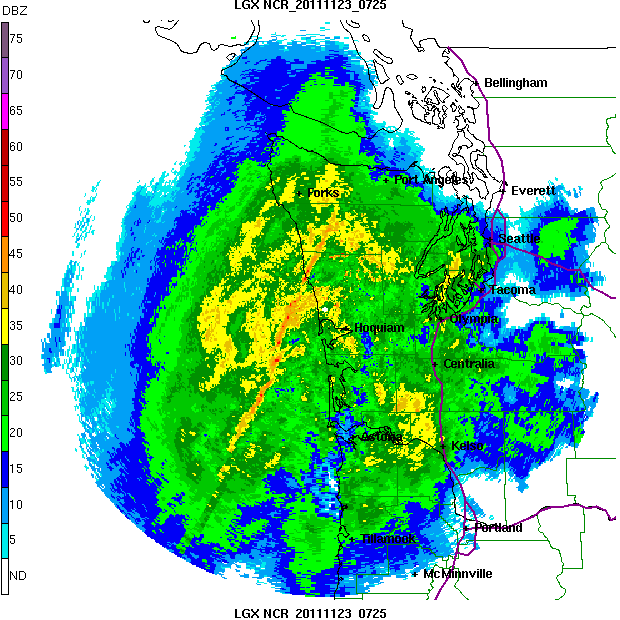
One of the most fascinating aspects of this storm was how we could see it on the coastal radar. Remember how I talked about that "thin band of heavy rain"? Check this image out.

11:25 pm PST Tue 22 Nov 2011 - Langley Hill Radar

If you look off the coast, you can see a very heavy band of precipitation off the Washington coast stretching into the Olympic Peninsula. This band actually stalled over this area for around 2 hours last night. If this happened in Seattle, catastrophic flooding would have resulted. The last time something like this happened in Seattle was between 4 and 5 P.M. on December 14, 2006, where Seattle received around an inch of rain in one hour. 

Seattle has seen some urban flooding, but the rivers have seen more. Although this wasn't a major flooding event for the rivers, as snow levels didn't rise super high, some rivers did see some flooding. Most of these rivers are still rising, and the graphic below shows their expected crests. The Skokomish River is expected to experience major flooding, and the Stillaguamish will experience moderate flooding. The Chehalis, at this point, looks to only experience minor flooding, as less rain fell than forecast over the Olympics. If snow levels were higher with this storm, I'm sure that most rivers in Western Washington would experience flooding, with several getting to major flood stage.


Another big aspect of this storm was the wind it brought to the Oregon Coast. It was breezy here, but the Oregon Coast experienced some scarily strong winds. The model below is from last night and shows the expected winds at 1 A.M. this past morning. The winds have since died down, but they are still strong from the central Oregon coast southward.

Valid 01:00 am PST Wed, 23 Nov 2011 - 9hr Fcst - UW 00z 12km WRF-GFS 10m wind speed, SLP

50 knots sustained! That is approaching hurricane force, and there were certainly hurricane-force gusts. I'll get the highest gusts from this storm later when I can find them online. 

On Thursday, we'll have to deal with another batch of heavy rain, wind, and mountain snow. This system will be weaker than the last one and will move by much more quickly, but it will still be a big November storm and will give us some pretty gnarly weather. 

The latest model run shows some very strong winds for the coast, with sustained winds reaching 45 knots. The north interior will also get blasted as well. A storm warning is in effect for the coast, and the north interior has a storm watch. We'll have to watch the next model runs closely.

Valid 01:00 pm PST Thu, 24 Nov 2011 - 33hr Fcst - UW 12z 4km WRF-GFS 10m wind speed, SLP

For travelers, the  biggest problem this storm will pose is a threat of significant mountain snow.

Valid 04:00 am PST Fri, 25 Nov 2011 - 48hr Fcst - UW 12z 4km WRF-GFS 24-hour snowfall

The snow level will be around 2,000 feet, and models are showing up to a foot of snow in places. I would not be surprised if these amounts turned out to be higher though.

Class in 3 minutes, gotta go!
Charlie